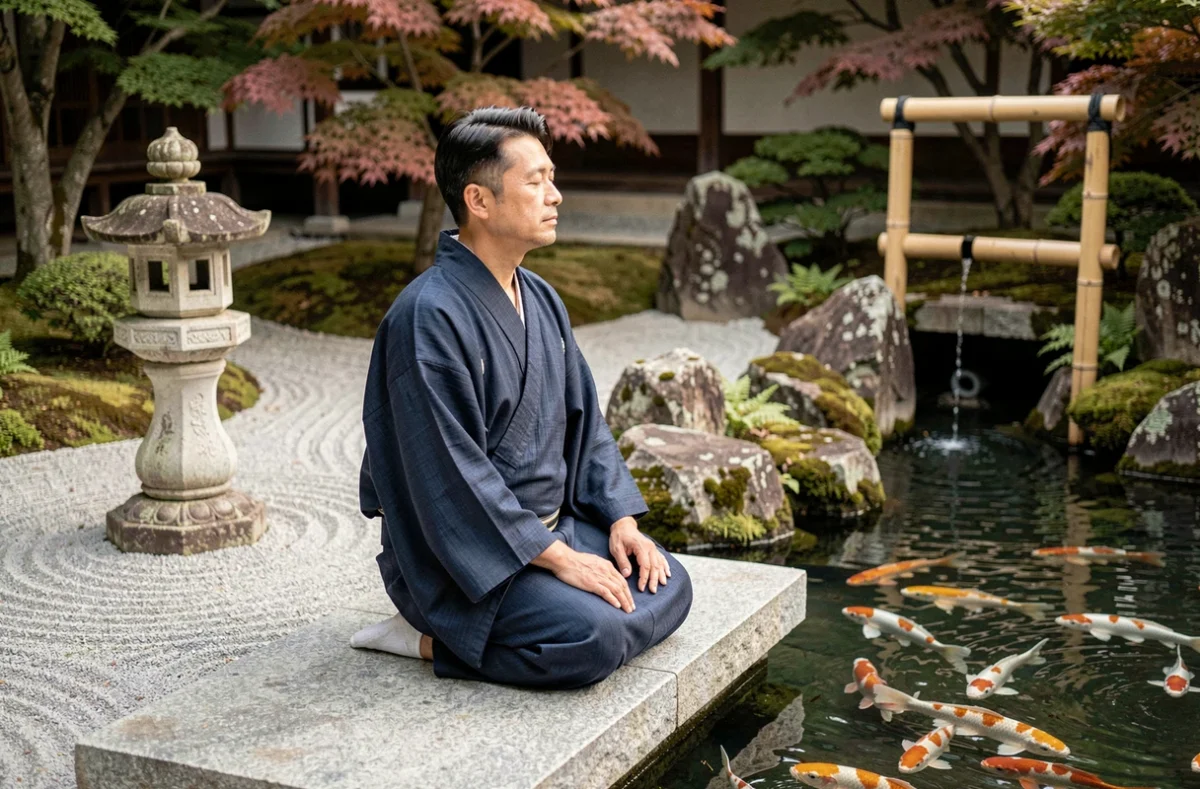
Godai is a classification system rooted in Japanese esoteric Buddhism that organizes reality into five categories: earth, water, fire, wind, and void. Unlike a purely material framework, these categories primarily describe qualities of experience, setting godai apart from the elemental systems found in other Asian traditions.
Godai and the Chinese Five Phases: Two Systems Not to Confuse
When people first encounter godai, they often compare it to the Chinese model of the Five Phases (wuxing). Both systems have five terms, but their components differ. Wuxing links wood, fire, earth, metal, and water in a cycle of mutual generation and destruction. Buddhist godai comprises earth, water, fire, wind, and void (or space), with no cyclical dynamic between them.
This distinction is more than cosmetic. Wuxing works as a system of correspondences: seasons, organs, colors, and cardinal directions are linked according to relationships of production or control. Godai, by contrast, describes ways of being. Earth represents solidity, water cohesion and fluidity, fire warmth, wind movement, and void what lies beyond direct sensory perception.
Confusing the two erases godai’s Buddhist roots. While wuxing belongs to a Confucian and Taoist cosmology, godai originates in the texts of Japanese Shingon Buddhism. To explore the Japanese philosophy of the five elements of godai, you must first recognize that it does not work as a copy of Chinese thought.
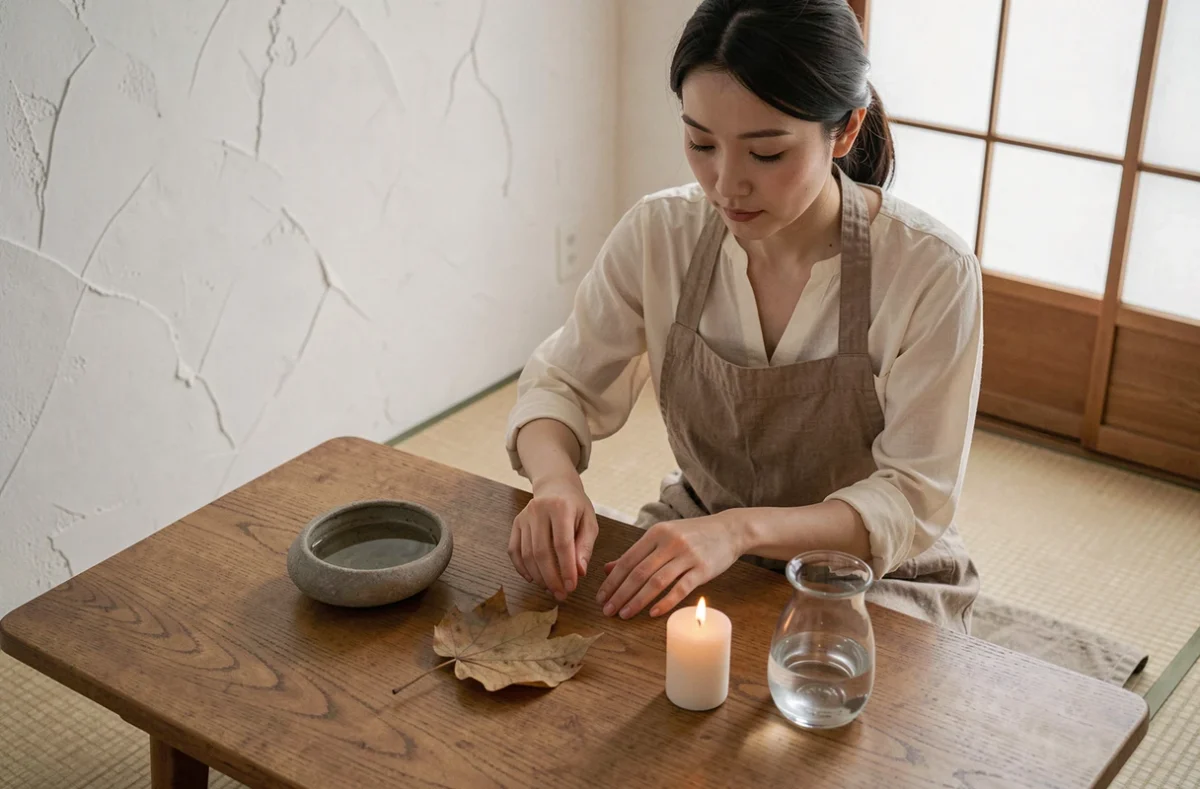
Five Bodily Qualities Rather Than Five Substances
Reducing godai to a list (earth, water, fire, wind, void) can lead to a misunderstanding. It is easy to picture substances or blocks of matter. Buddhist tradition offers a different perspective: each element names a quality that can be observed in the body and in everyday experience.
- Earth (chi) represents resistance and support. Bones, muscles, the ground beneath your feet: anything that does not immediately yield to pressure embodies this quality.
- Water (sui) represents cohesion and adaptability. Blood, saliva, and a liquid’s ability to take the shape of its container illustrate this property.
- Fire (ka) corresponds to transformation through heat. Digestion, metabolism, and body heat: fire is not a flame but a process of conversion.
- Wind (fū) is the principle of movement. Breath, circulation, gestures: all movement, internal or external, belongs to wind.
- Void (kū) is distinct from the four preceding elements. It represents what makes experience possible without being perceptible in itself, like the space through which sound travels.
Reading godai this way turns the list into a framework for observation. A Japanese martial arts practitioner, for example, can analyze their posture (earth), fluidity (water), explosiveness (fire), movement (wind), and ability to remain mentally open (void).
The Gorintō: Godai Carved in a Stone Memorial
The gorintō is a stone monument found in cemeteries and temples associated with Japanese esoteric Buddhism. Its shape consists of five stacked geometric sections, each linked to an element of godai: a cube for earth, a sphere for water, a pyramid for fire, a semicircle for wind, and a teardrop or jewel shape for void.
Its primary purpose is ritual and funerary. The gorintō serves as a focus for devotion and a memorial to the deceased, not as a simple garden ornament. In the Shingon tradition, it embodies the idea that the deceased’s body returns to the five elements that make up all phenomenal reality.
One construction detail is worth noting: wind and void are sometimes carved together as a single piece. The gorintō therefore cannot always be read as five distinct blocks mechanically stacked on top of one another. The monument’s overall form takes precedence over the number of its parts, reflecting the Buddhist idea that the elements are not separate entities but aspects of a single reality.
A Sixth Principle Absent from the Stone
Some explanations from the Shingon tradition add a sixth term to the five elements: consciousness (shiki). This principle has no stone in the gorintō precisely because it is not material. Consciousness permeates and animates the five elements without being reducible to any one of them. This distinction reminds us that godai describes the phenomenal world, not the entirety of experience.
Godai and Everyday Life in Japan
Godai has not remained confined to Buddhist texts. Its vocabulary informs several areas of Japanese culture, from martial arts and architecture to calligraphy.
In traditional martial arts, the five elements are sometimes used as a framework for classifying stances or types of attack. Earth corresponds to a low, stable guard, fire to an upward strike, and wind to a lateral movement. These associations are not universal across schools, but the conceptual framework remains the same.
Godai therefore functions less as an abstract theory than as a shared vocabulary for describing relationships with the world. Its strength lies in its flexibility: each field (ritual, martial arts, architecture) adapts it without distorting it, because the five terms describe qualities of experience rather than fixed objects.