
The choice of a hedge trimmer relies less on raw power and more on the suitability between the spacing of the teeth, the length of the blade, and the type of vegetation to be maintained. We find that most guides focus on the motorization without ever addressing the cutting geometry, whereas it is this that determines the quality of the result on the ground.
Tooth spacing and blade length: the parameters that dictate the cut
A hedge trimmer with tight tooth spacing is suitable for boxwood or privet hedges, where the branches remain thin. For a laurel or hornbeam hedge with more woody branches, a wider spacing is necessary to prevent the blade from clogging and tearing instead of cutting.
The tooth spacing dictates the maximum allowable branch diameter. Checking this information on the technical sheet avoids unpleasant surprises: a device presented as powerful but equipped with tight teeth will struggle with semi-hard wood.
The blade length is chosen based on the width of the hedge. A short blade offers more precision for topiaries and complex shapes. A long blade covers more surface area in one pass but makes the tool heavier and reduces maneuverability in a vertical position.
We recommend measuring the actual thickness of the hedge before purchasing: there’s no need to get an oversized blade if the hedge doesn’t exceed the width of an arm. On taille-haie-warrior.com, the product sheets detail these characteristics by model, making technical comparison easier.

Multi-tool battery platforms: thinking in ecosystems rather than isolated devices
The classic mistake is to buy a battery hedge trimmer without checking compatibility with the rest of the tools. Several manufacturers now offer universal battery platforms (Bosch Power for All, Makita LXT, Stihl AS System) that allow the same battery to be used on a blower, a brush cutter, or a hedge trimmer.
This model changes the purchasing logic. The cost of the battery and charger often represents the largest portion of the total price. If you already own a tool from a given platform, buying a compatible hedge trimmer halves the budget since the power unit is already acquired.
Capacity and actual autonomy
The nominal voltage (18 V, 36 V, 40 V) gives an indication of power, but autonomy mainly depends on the amp-hour capacity of the battery and the type of vegetation being cut. A dense hedge puts more strain on the motor and reduces effective working time.
For an average-length hedge, a standard battery is sufficient. For significant linear lengths, planning for a second battery or opting for a model with fast charging remains the most reliable solution.
Gas hedge trimmers and municipal restrictions: a criterion often overlooked
Gas trimmers maintain an advantage for very long country hedges where unlimited autonomy and cutting power make a difference. However, more and more municipalities are imposing strict time restrictions on noisy garden tools, including in private gardens.
Municipal regulations vary from city to city, but the general trend is towards tightening: prohibition on Sundays, limited hours during the week, and sometimes complete bans on holidays. For a homeowner who can only trim on weekends, a gas model may become unusable for a good part of the year.
Balancing power and regulatory practicality
We observe a clear shift towards battery models, even among users who previously used gas. Platforms of 36 V and above now offer sufficient torque for semi-hard branches while remaining at noise levels compatible with unrestricted use.
- Check your municipality’s regulations before investing in a gas model: the allowed time slots condition the profitability of the purchase.
- If your hedge exceeds the maximum cutting diameter of the hedge trimmer, a pruner or power shears will still be necessary as a supplement, regardless of the type of motorization.
- Maintaining a gas engine (spark plug, air filter, oil-gas mixture) adds a cost and maintenance time that the battery eliminates.
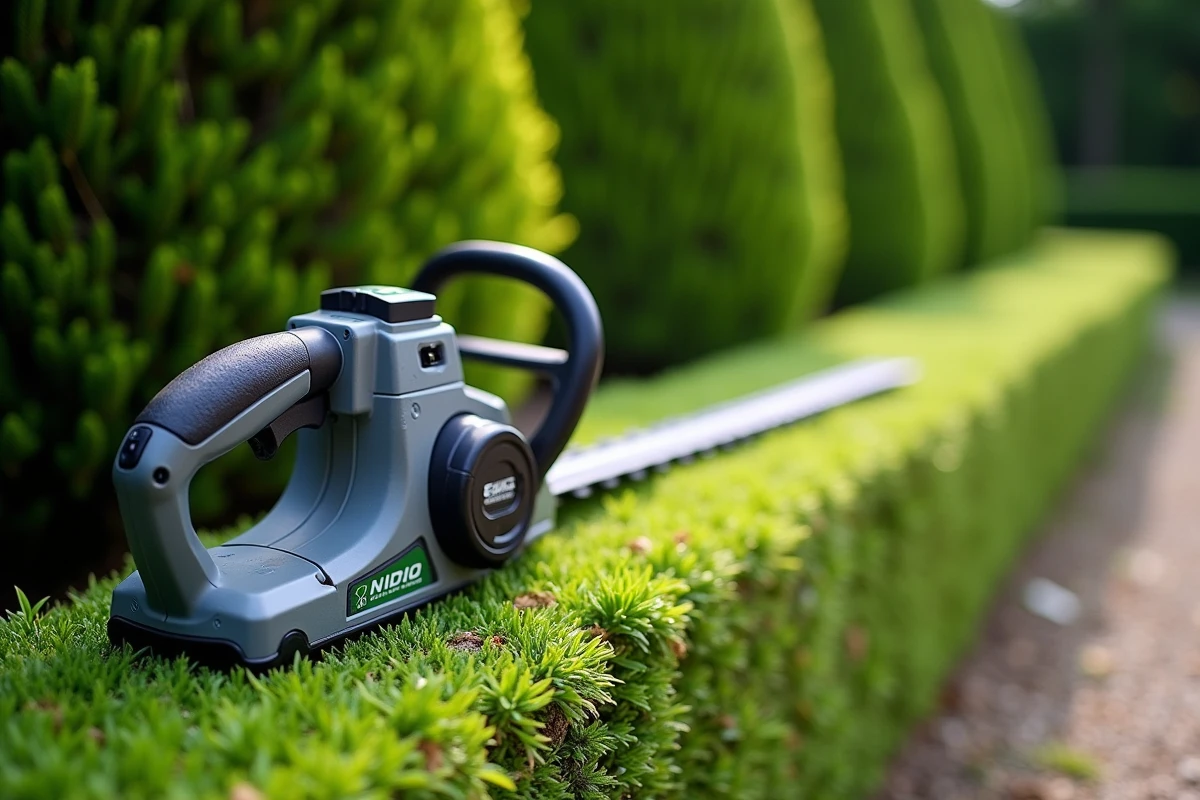
Weight, ergonomics, and cutting position: what matters after the first half hour
The technical sheet displays an empty weight. In real conditions, you need to add the battery or account for the weight of a full gas engine. Beyond a few kilograms, arm and shoulder fatigue increases quickly, especially when cutting vertically on the sides of the hedge.
The rotating handle is an underestimated criterion. A hedge trimmer with a rotating rear handle allows you to switch from horizontal cutting (top of the hedge) to vertical cutting (side) without twisting the wrist. Over a complete trimming session, the difference in comfort is significant.
Balance and center of gravity
A well-balanced device feels lighter than a technically lighter model but poorly distributed. The center of gravity should be close to the hands. Models where the battery is housed at the back of the handle often present better balance than those where it is fixed under the motor.
Testing the grip before purchase remains the best selection filter. Paper data does not reflect the real sensation of arms extended at shoulder height for several minutes.
The best hedge trimmer for a garden is not the most powerful or the cheapest. It is the one whose blade geometry matches the vegetation, whose battery integrates into an existing tool park, and whose weight allows you to finish trimming without pain. Check your municipality’s regulations, measure your hedge, and start from these concrete constraints rather than a marketing sheet.