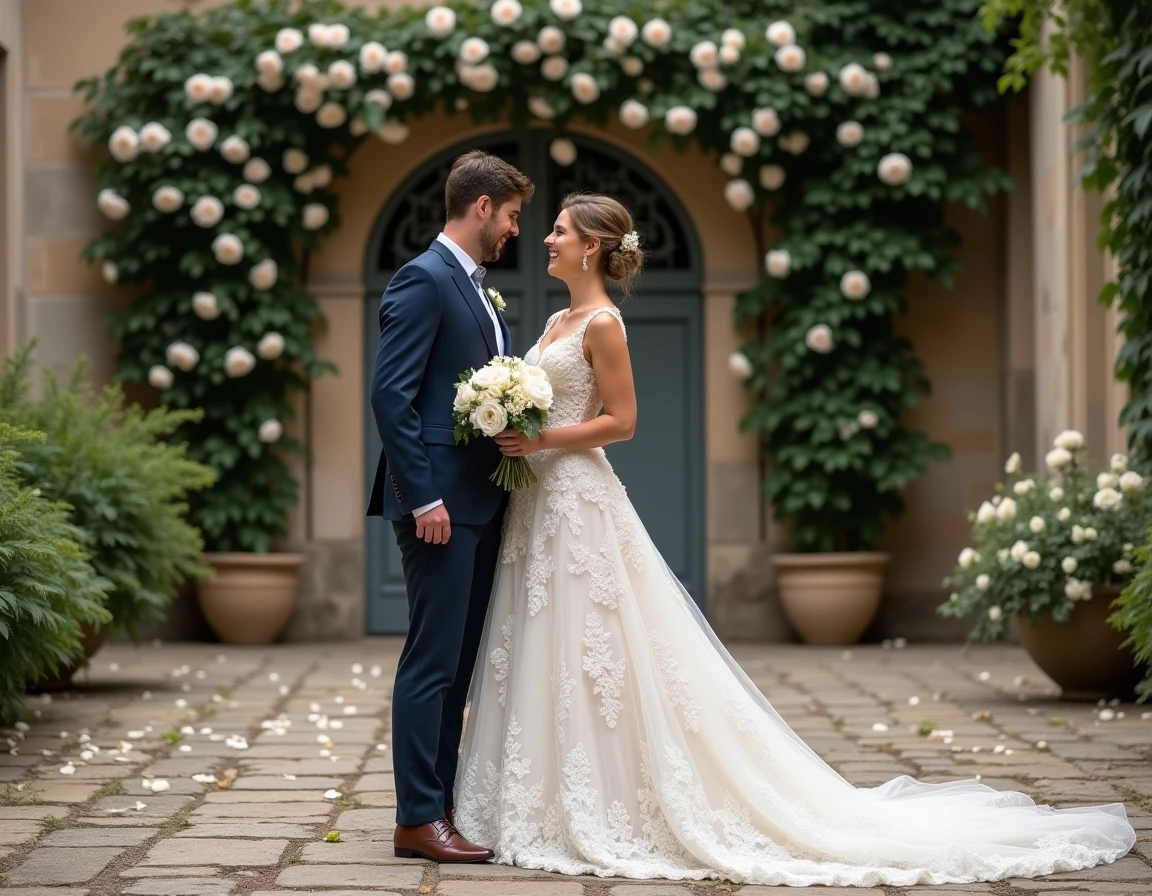
Organizing a wedding in France rarely starts with choosing the dress or the caterer. The first decision, which conditions everything else, revolves around the calendar and geography. These two variables determine the budget far more than the number of guests or the style of decoration.
Reception venue in France: the geographical gradient that no one budgets for

You are looking for a venue with a park, exposed stone, and capacity for around a hundred guests. The entry price for this service varies from simple to five times as much depending on the city. According to Alpha-Réception, renting a hall starts at around 500 euros in Clermont-Ferrand, compared to 2,500 euros in Bordeaux. In between, Lyon is around 1,500 euros, Paris about 1,000 euros, and Toulouse close to 2,000 euros.
These discrepancies concern comparable formats. In other words, with the same number of guests, the choice of region weighs as heavily as that of the caterer in the overall budget. A couple willing to celebrate two hours away from their city can save several thousand euros for other expenses.
To compare providers by geographical area and evaluate packages, you can find more information on Info Mariage by consulting their detailed listings by region.
Weekday or off-season weddings: a trend that changes prices

Since 2023, weddings organized from Monday to Thursday or in the off-season (November to March) have been on the rise. The reason is not solely budgetary. Postponements related to Covid have saturated summer Saturdays, and many couples have discovered that these off-peak slots offer much greater availability.
Some venues now offer specific pricing grids for weekday weddings, with significant discounts compared to Saturdays from May to September. The savings extend beyond the venue: photographers, florists, and caterers also adjust their rates for these less sought-after slots.
Why is this choice still underestimated? Many couples dismiss the idea reflexively, thinking their guests won’t be able to free themselves. In practice, a wedding on a Thursday or Friday outside of school holidays attracts close ones almost as well as a Saturday, provided they are notified well in advance.
Wedding budget: the items to negotiate before signing
The budget for a wedding is not just about adding up quotes. It involves a series of negotiations between competing items. Three items absorb the majority of the budget: the venue, the caterer, and drinks. The rest (photography, music, decoration, attire, stationery) shares the remainder.
The classic trap is to sign for the reception venue without estimating the cost of the caterer. However, in many venues, the caterer is imposed or must be on an approved list, which limits negotiation. Checking this point before booking avoids surprises in the four-figure range.
DIY as a real lever for cost reduction
Do-it-yourself is not just about decoration. Some couples report a reduction of half, or even two-thirds, on decoration and stationery items by making their own invitations, centerpieces, signage, and guest favors.
For DIY to work without generating stress, it needs to be planned as a distinct item:
- Start making items at least four months before the big day to account for mishaps and delivery delays of supplies
- Limit DIY to two or three manageable elements rather than trying to do everything, which turns preparation into a chore
- Engage a small group of motivated friends for dedicated workshops, providing templates and ready-to-use materials
Civil, secular, or religious ceremony: what the format changes concretely
The visit to the town hall remains mandatory for the union to be legally recognized. Any other ceremony (religious, secular) is added to this administrative step. This point may seem obvious, but it conditions the day’s schedule.
A civil ceremony lasts on average about twenty minutes. If you add a secular outdoor ceremony, plan for an additional forty-five minutes to an hour, plus travel time between the town hall and the reception venue. Many couples underestimate this timeframe and compress the cocktail or meal.
The secular ceremony offers total freedom over the content (texts, music, symbolic rituals), but it requires specific preparation. Without an experienced officiant, the risk of lengthy or awkward moments is real. Entrusting this role to a friend means allowing them time to prepare a proper script.
Guest list and seating plan: two distinct exercises
The guest list should be set early, ideally at the same time as the venue, as it determines the necessary capacity. Finalizing the list at least six months in advance allows for sizing the caterer, furniture, and stationery without last-minute adjustments.
The seating plan, on the other hand, does not need to be finalized until the last two weeks. Late cancellations and last-minute confirmations change the game. Working on a seating plan too early means redoing the work three times.
A often-overlooked criterion: check that the venue allows the desired table configuration. Round tables for eight, a single long table, U-shape – each format has different space constraints. The venue or hall may impose a default arrangement.
- Round tables: friendly, but require more floor space than a rectangular table for the same number of covers
- Large single table: spectacular in photos, but complicates interactions beyond thirty guests
- Mixed arrangement: combines a rectangular head table and round tables for other groups
The choice of ceremony format, calendar, and region weighs more heavily than most aesthetic details on which couples spend weeks. Making these three decisions first frees up time and budget for everything else.