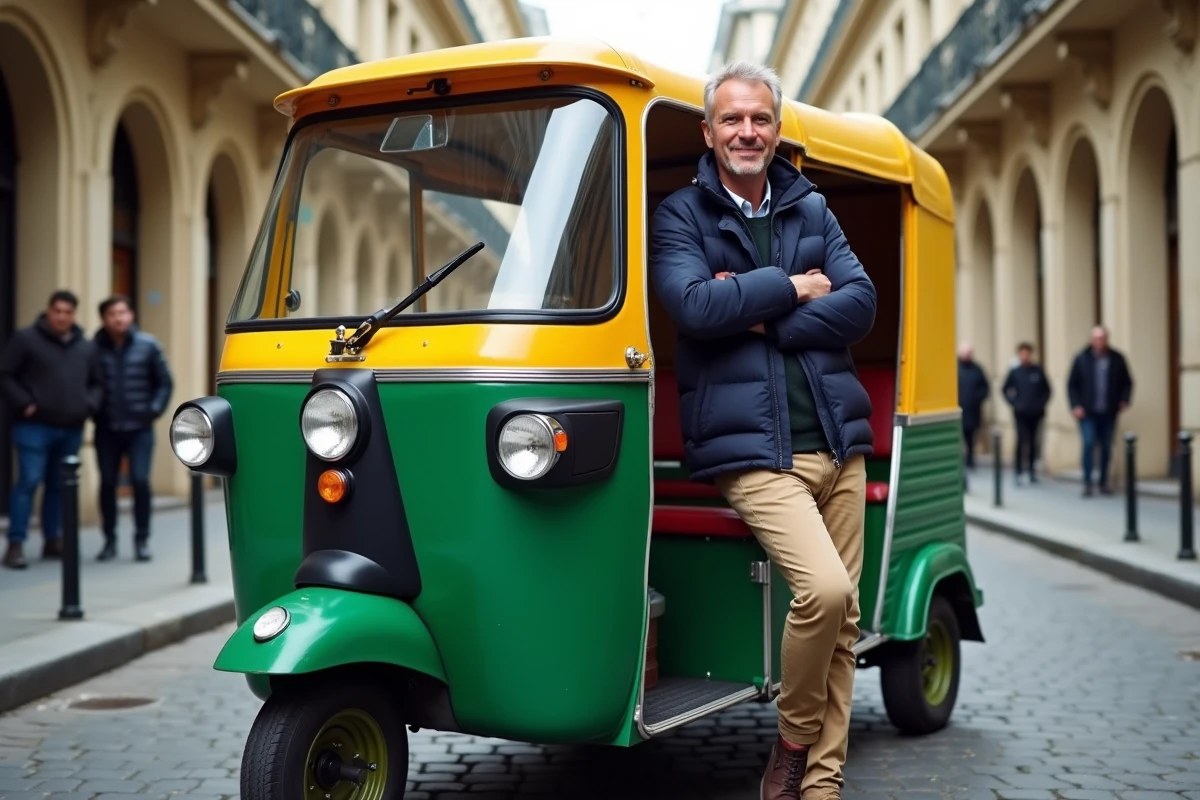
An electric tuk-tuk operator sets up their business at the Old Port of Marseille, obtains their professional license, and then discovers that the neighboring municipality requires a separate authorization. This type of situation illustrates the daily life of a sector caught between several regulatory blocks that are not dedicated to it. Understanding the regulation of tuk-tuks in France requires going beyond generalities about the Transport Code to identify the actual operational constraints.
Tuk-tuk and local public markets: the lever that few operators anticipate
In recent years, several local authorities have stopped merely tolerating tuk-tuks on their territory. They are directly integrating them into public contracts or public service delegations to serve historic centers or areas with high tourist traffic.
The city of Avignon, for example, has launched an experiment with electric motorized tricycle tourist shuttles under a municipal agreement to serve the intra-muros area. The specifications require electric motorization, a specific training program for drivers, and regulated pricing.
This trend profoundly changes the economic model of the sector. An operator responding to a municipal tender no longer has the same risk profile as a freelancer offering tourist rides. Participating in a public market secures the operation but imposes heavy constraints: compliance with specifications, activity reporting, and continuity of service obligations.
For entrepreneurs considering this route, it is useful to consult the regulation of tuk-tuks in France to understand the obligations before responding to a tender. Feedback varies on this point: some municipalities support project holders, while others publish very technical tenders without prior dialogue.
Legal status of the tuk-tuk: between T3P, VMDTR, and a senatorial bill proposal
The fundamental problem of the tuk-tuk in France lies in the absence of a legal category specific to it. The vehicle is attached to two distinct regulatory blocks, and their overlap creates uncertainty.
- The Transport Code classifies the paid transport of persons under the regime of Particular Public Transport of Persons (T3P), aligning the obligations of the tuk-tuk with those of VTCs and taxis: professional license, registration in the registry, specific insurance.
- The Road Code categorizes the tuk-tuk as a Motorized Vehicle with Two or Three Wheels (VMDTR), with its own requirements for homologation, technical control, and appropriate driving license.
- A bill submitted to the Senate aims to assimilate tuk-tuks to small tourist trains under certain conditions, which would exempt them from the heaviest T3P and VMDTR constraints. This text has not yet been finalized.
On the ground, this dual legal status generates concrete blockages. In Le Havre, tuk-tuks operated for an entire summer before being banned from circulation due to a lack of applicable framework. The prefecture considered that the vehicle did not correspond to any existing legislation, while the operator believed they were compliant with VTC rules.
What the assimilation to small tourist trains would change
If the senatorial proposal were to succeed, tuk-tuks operating in a tourist framework would benefit from a simplified regime. The criteria considered include maximum speed, geographical operating area, and the irregular nature of the service. The operator would no longer need a VTC license or T3P registration, provided they remain within the defined perimeter.
This distinction between tourist use and on-demand transport is central. A tuk-tuk that conducts guided tours in a city center does not have the same profile as a vehicle bookable via an app for point-to-point trips.
Low emission zones and electric tuk-tuks: a real competitive advantage
The ZFE (Low Emission Zones) deployed in major French urban areas create a natural filter in favor of 100% electric tuk-tuks. Paris, Lyon, Montpellier, and Bordeaux explicitly include motorized tricycles in their climate-air-energy plans, prioritizing zero-emission vehicles for fine service in city centers.
The Territorial Climate Air Energy Plan 2025-2030 of the Lyon Metropolis mentions prioritizing “atypical electric modes for fine service in city centers.” This type of wording directly influences tenders and operating authorizations.
A thermal or hybrid tuk-tuk imported becomes effectively unexploitable in these zones. For an entrepreneur launching their project, choosing an electric vehicle is no longer a marketing argument but a condition for market access.
Entry cost and economic viability
The electric vehicle represents a higher investment than its thermal equivalent. Added to this are the French homologation (which may require adaptations on an imported model), T3P professional insurance, and training-related costs.
The model works best in two specific scenarios:
- Operation under a municipal agreement or DSP, which guarantees a minimum activity volume and sometimes privileged access to certain pedestrian areas.
- Seasonal activity in coastal or tourist areas, where demand concentrates over a few months with higher rates.
- Event services (weddings, fairs, festivals), which allow for higher unit margins than regular transport.
Outside of these niches, profitability remains fragile. The limited number of passengers per trip (two to three people depending on the models) and speed constraints reduce potential revenue compared to a classic VTC.
License, training, and insurance: the operational prerequisites for operating a tuk-tuk
Regarding driving licenses, the category depends on the power and weight of the vehicle. Most tuk-tuks operated in France require at least a category B license, but some heavier models require a specific category. Checking the exact homologation of the model before purchase avoids costly administrative blockages.
Professional insurance covers the civil liability of the transporter and passengers. There are few insurers specialized in passenger transport that offer contracts suitable for tricycles, which limits competition and keeps premiums high.
Training covers both vehicle operation (stability in turns, braking specific to three wheels) and T3P regulations. For operators targeting a tourist market, certification as a guide or commentator enhances the offer and justifies a higher rate.
The tuk-tuk sector in France remains suspended to legislative evolution. As long as the senatorial bill has not been finalized, each operator navigates an assembly of rules designed for other vehicles. Local authorities that integrate these tricycles into their tenders are paving a pragmatic path, but it remains local and fragmented.